

A toileter is a person who needs help getting on and off the toilet—sometimes temporarily, sometimes long-term.
That’s it.
No euphemisms.
No pretending this isn’t happening.
Toileters are a large, diverse group. They are people living ordinary lives confronting dependency for a basic human function: “going to the bathroom”. It’s a need that combines urgency, privacy, and physical risk.
Toileter isn’t one demographic
Toileters come from every age group, diagnosis, and stage of life. What they share is not a condition—it’s a moment when their body, environment, and timing don’t line up safely.
1) People living with permanent disabilities (any age)
Some people have managed toileting independently for years—until pain, fatigue, spasticity, or changing strength alters what’s possible. What once worked no longer feels safe. The challenge isn’t learning how to toilet; it’s adapting when the body changes faster than the environment does.
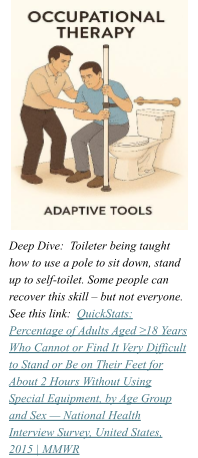
2) Older adults whose balance or endurance has shifted
Many older adults appear steady during the day, when they are in well-lit rooms, on good surfaces. Toileting is different. Bathrooms are tight. Urgency increases. Nighttime adds darkness and stiffness. The risk concentrates in a space designed without aging bodies in mind.
3) People in short-term recovery
After surgery, hospitalization, or injury, people often need toileting help for days or weeks. Because the need is “temporary,” it’s easy to overlook the risk. But temporary need does not mean temporary danger. Falls during recovery can undo progress quickly.
4) People whose mobility has changed after a health event
Stroke, progressive neurological conditions, repeated falls, or complications can create a new reality. The hardest part is often not physical—it’s emotional. Accepting help. Losing privacy. Worrying about being a burden. Toileting becomes the most visible symbol of lost independence.
5) Night-time toileters
Some people only need help at night—when lighting is low, reaction time is slower, and urgency is high. Night-time toileting is where fear often peaks: Do I wait? Do I wake someone? Do I try to manage alone? This is not an edge case. It’s a predictable risk pattern.
Why toileting transfers are uniquely challenging
Toileting transfers combine three forces at once:
- Urgency — people rush
- Privacy — people hide needs or resist help
- Physical risk — small spaces, awkward angles, unstable footing
That combination makes toileting transfers different from other mobility tasks. It’s not just “another transfer.” It’s a moment where dignity and safety are constantly negotiating with each other.
When systems treat toileting as routine, they ignore the reality toileters live with every day.
Independence isn’t one thing
Independence is often talked about as if it’s binary—you either have it or you don’t. Toileters know that’s not true.
Someone can:
- Walk independently but struggle with transfers
- Toilet independently during the day but not at night
- Manage safely at home but not in unfamiliar environments
- Appear independent while quietly taking unsafe risks
This is why blanket solutions fail. Toileters don’t need slogans about independence. They need support that reflects how their bodies actually work, in real spaces, under real conditions.
Equipment vs. personal assistance: what actually helps?
Toileters are surrounded by promises:
- “This device will keep you independent.”
- “This assistance protects your dignity.”
What’s rarely discussed are the tradeoffs.
Some solutions keep people upright but dependent.
Some protect caregivers but remove participation.
Some preserve dignity on paper while increasing fear in practice.
In the next post, we’ll look at what’s currently available—grab bars, raised seats, bedside commodes, lifts—and talk honestly about what they do well, where they fall short, and why “independence” can mean very different things depending on who you ask.
Because everyone claims dignity.
Only some designs actually deliver it.
Why PPAL starts with toileters
PPAL begins with toileters because systems don’t change unless the lived experience is understood first.
Toileters are not problems to be managed.
They are people navigating daily life in environments that haven’t kept up.
By naming toileters clearly—and listening to them directly—we create space for better design, safer systems, and reforms that reflect reality rather than assumptions.
PPAL is building a toileting reform movement grounded in lived experience, plain language, and dignity by design. If you are a toileter or a caregiver, your voice belongs in this work.